
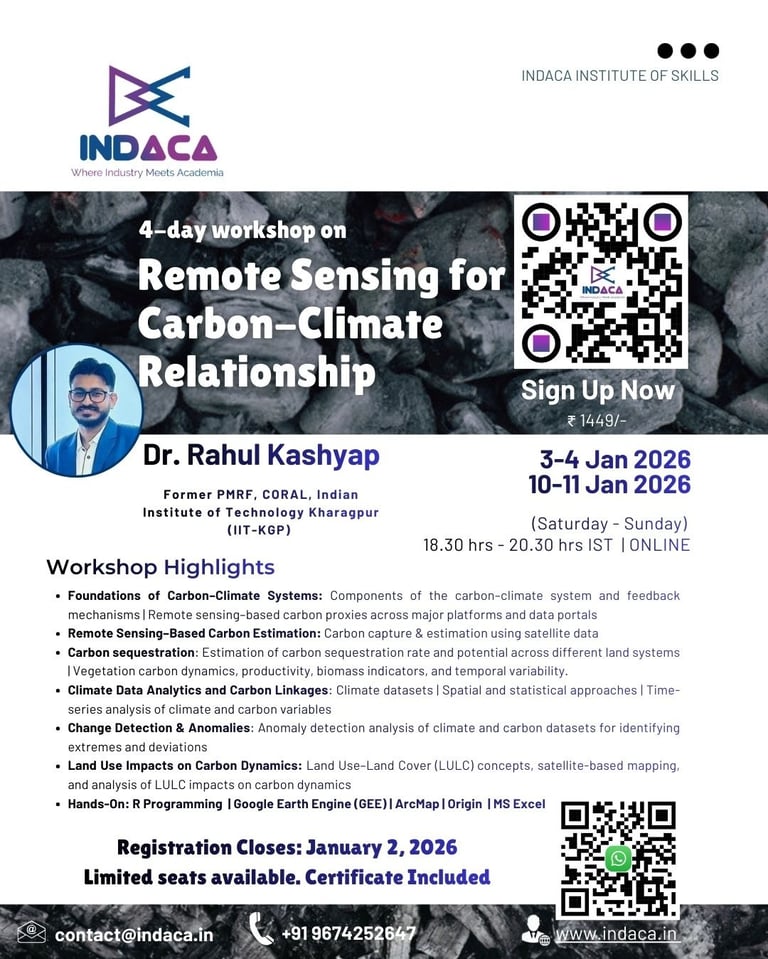
4 Day Workshop on Remote Sensing for Carbon-Climate Relationship
Enroll now—master carbon–climate analysis with remote sensing
Dates: Jan 3-4 and Jan 10-11, 2025
Time: 6:30 PM - 8:30 PM (IST) | Saturday and Sunday
Mode: Online (via Zoom)
Instructor: Dr. Rahul Kashyap, Former Prime Minister’s Research Fellow (PMRF), at Centre for Ocean, River, Atmosphere and Land Sciences (CORAL), Indian Institute of Technology Kharagpur (IIT-KGP), India.
Workshop on Remote Sensing for Carbon-Climate Relationship
Step into the future of climate intelligence—master carbon–climate analysis with remote sensing and turn data into impactful insights.
Course Highlights
✔ Understand carbon–climate system fundamentals
✔ Learn remote sensing–based carbon estimation techniques
✔ Hands-on analysis of carbon capture & sequestration
✔ Explore global climate and carbon datasets from trusted portals
✔ Perform time-series analysis and anomaly detection
✔ Assess long-term climate and carbon trends
✔ Analyze LULC changes and their carbon implications
✔ Real-time demonstrations using industry-relevant tools
✔ Practical workflows applicable to research, policy, and projects


Who Should Enroll
Students & Research Scholars (Geography, Environmental Science, Climate Science, GIS, Remote Sensing)
PhD & Master’s students working on carbon, climate, or sustainability themes
GIS & Remote Sensing professionals
Climate & environmental analysts
Urban, regional, and environmental planners
Academicians and early-career researchers
Anyone interested in carbon accounting and climate data analysis


Course Highlights
Foundations of Carbon–Climate Systems: Introduction to carbon–climate relationships and their significance in global change studies | Key components of the carbon–climate system and feedback mechanisms | Fundamentals of remote sensing for environmental and climate applications | Exploration of remote sensing–based carbon proxies (vegetation indices, surface properties, biophysical indicators) across major platforms and data portals
Remote Sensing–Based Carbon Estimation: Conceptual understanding of carbon capture and its estimation using satellite data | Carbon sequestration: principles, pathways, and remote sensing–based assessment methods | Estimation of carbon sequestration rate and potential across different land systems | Analysis of vegetation carbon dynamics, including productivity, biomass indicators, and temporal variability.
Climate Data Analytics and Carbon Linkages: Accessing and exploring climate datasets from global and regional platforms | Investigating climate–carbon interactions using spatial and statistical approaches | Time-series analysis of climate and carbon variables to assess variability, trends, and seasonal patterns
Change Detection, Anomalies & Land Use Impacts: Anomaly detection analysis of climate and carbon datasets for identifying extremes and deviations | Estimation of long-term changes and trends in key climate and carbon components | Land Use–Land Cover (LULC) concepts, satellite-based mapping, and analysis of LULC impacts on carbon dynamics
Frequently Asked Questions
What is the workshop about?
The workshop focuses on remote sensing for carbon-climate interactions, covering various analytical tools.
What tools will be covered?
What is the course duration?
Is this workshop beginner-friendly?
Yes, the workshop is designed for beginners to intermediate participants.
Participants will gain hands-on experience with Google Earth Engine, ArcMap/QGIS, R, MS Excel, and Origin.
The course runs on Jan 3-4 and 10-11, 2026, from 6.30 –8.30 PM IST.
Tools covered include Google Earth Engine, ArcMap/QGIS, R, MS Excel, and Origin.

Contact Us
Get in touch for workshop inquiries and registration.
Remote Sensing Workshop Registration
Secure your spot now to gain practical expertise in analyzing carbon-climate interactions using cutting-edge geospatial technologies. Limited seats available for an immersive learning experience!
Registration Closes: Jan 2, 2026
Contacts
contact@indaca.in
Socials
Subscribe to our newsletter
Copyright © 2025 Indaca Institute of Skills, All rights are reserved
WhatsApp: (+91) 9038413517
Call: (+91) 7439308037